
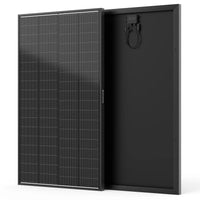
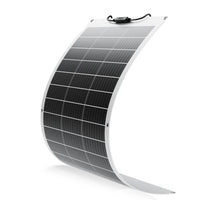
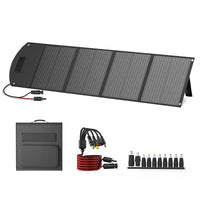
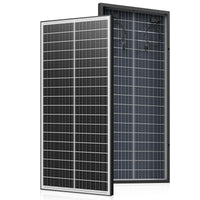
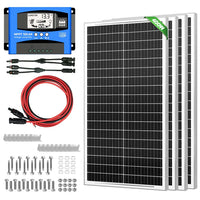

Many users are surprised when their “200W” solar panel rarely shows 200 watts in daily use. In reality, this behavior is not only normal — it is expected. The gap between nameplate power and real-world output is primarily driven by physics, not misleading specifications.
Understanding why this happens requires looking beyond the wattage label and into how solar panels are rated, how temperature affects cell performance, and why two panels with identical specifications can behave very differently outdoors.
What “200W” Actually Means
A 200W solar panel is rated under Standard Test Conditions (STC), which assume:
-
Cell temperature: 25°C (77°F)
-
Solar irradiance: 1000 W/m²
-
Air mass: AM1.5
-
Perfect orientation and no shading
These conditions are useful for laboratory comparison, but they are rarely achieved in real installations. Once a panel is installed outdoors, cell temperature almost always exceeds 25°C — often by a wide margin.
As a result, the STC rating should be understood as a reference value, not a guaranteed real-world output.
Temperature: The Biggest Output Killer
In real-world testing, temperature has proven to be the most consistent factor reducing output.
On a mild, sunny day with ambient temperatures around 25–30°C, panel surface temperatures commonly reach 50–55°C. In hotter climates, even higher cell temperatures are routine.
Most crystalline silicon panels have a temperature coefficient between -0.35% and -0.45% per °C. This means:
-
At 50°C cell temperature (25°C above STC), output loss can reach 9–11%
-
At 60°C, losses of 12–16% are common
Under these conditions, a 200W panel producing 145–165W is not underperforming — it is behaving exactly as physics predicts.
Wind, mounting height, and rear-side airflow can significantly affect how quickly a panel sheds heat, which is why the same panel may perform better on a breezy day than on a still, hot one.
Why Angle and Sunlight Aren’t the Whole Story
Panel tilt and orientation do matter, but in many field tests they explain less variation than temperature does.
Two panels mounted at similar angles, under identical sunlight, can show noticeably different outputs simply because one runs hotter than the other. This thermal behavior is often overlooked because it is not obvious from the spec sheet.
Why Identical Specs Can Produce Very Different Results
It is common to see two 200W panels with nearly identical datasheets behave very differently in practice. Key design factors include:
-
Heat dissipation efficiency
Frame thickness, backing materials, and ventilation gaps all influence operating temperature. -
Cell layout and interconnection
Different stringing methods and cell formats affect internal resistance and heat buildup. -
Temperature coefficient quality
A panel with a lower (less negative) temperature coefficient will retain more power as temperatures rise. -
Manufacturing tolerances
Small differences in lamination quality, soldering, and materials can compound under heat.
These differences often matter more in real-world use than small variations in rated wattage.
When 200W Is Possible
There are scenarios where panels can exceed their rated power:
-
Cold ambient temperatures
-
Strong sunlight with high irradiance
-
Good airflow across the panel surface
This is why users sometimes see 180–200W or even higher output during winter or cool, windy days. These conditions temporarily bring operating temperatures closer to — or even below — STC assumptions.
However, such performance should be viewed as a best-case scenario, not the baseline.
The Takeaway
A 200W solar panel producing around 150–165W in warm, real-world conditions is not defective, misleading, or “fake.” It is operating within the natural limits imposed by temperature and environment.
Rather than focusing solely on nameplate wattage, users evaluating solar performance should pay closer attention to:
-
Temperature coefficient
-
Mounting method and airflow
-
Local climate
-
Real-world thermal behavior
Understanding these factors leads to more realistic expectations — and better system design.


