
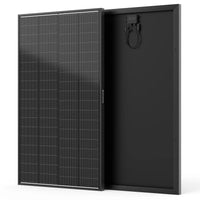

Walk through any neighborhood with solar installations, and you're looking at the result of a massive technology shift happening right now. Most homeowners don't realize their panels represent one of the fastest-evolving consumer technologies—faster than smartphones, electric vehicles, or home batteries.
N-type cell technology (TOPCon and HJT) is expected to overtake P-type (PERC) as the dominant market technology by the end of 2025. This transition happened remarkably fast—PERC dominated for nearly a decade, but newer technologies are replacing it in just 18-24 months of production ramp-up.
Understanding what's actually mainstream versus what's experimental matters because different technologies behave differently in real-world conditions—temperature response, shading tolerance, degradation rates, and long-term reliability all vary. Let's break down what you'll actually find on roofs today and what's coming next.
What's Actually on Roofs Right Now
Monocrystalline P-Type: The Workhorse (Declining Fast)
Traditional monocrystalline panels still dominate older installations. They're reliable, achieving 18-22% efficiency, and cheap due to massive Chinese production scale. These are single-crystal silicon cells with excellent consistency and proven 25-year track records.
Market Transition Accelerating: While Mono PERC panels still represent a significant portion of the market in 2025, the industry is rapidly shifting toward n-type technologies like TOPCon, which now comprise 75% of Chinese manufacturing.
PERC: Yesterday's Technology (2016-2024 Era)
PERC (Passivated Emitter and Rear Cell) technology represents a significant advancement over traditional crystalline silicon solar cells, incorporating a sophisticated passivation layer on the rear surface to dramatically improve light absorption and energy.
PERC panels improved efficiency to 21-23% and handled heat better than earlier mono panels. Manufacturing costs for PERC cells remain approximately 47% lower than emerging TOPCon alternatives.
However, PERC has limitations: moderate resistance to light-induced degradation, higher annual degradation rates of 0.6-0.8%, and maximum bifaciality limited to 70%.
Current market reality: Expected to achieve cost parity with PERC by 2025-2026 means PERC is rapidly becoming obsolete for new EcoBoss residential solar installations.
The New Mainstream: N-Type TOPCon (2024-Present)![]()
![]()

N-Type segment is expected to account for 53.6% share of the market in 2025, owing to superior efficiency and durability.
TOPCon (Tunnel Oxide Passivated Contact) technology represents the next evolutionary leap in solar cell engineering, utilizing an ultra-thin tunnel oxide layer combined with heavily doped polysilicon contacts to achieve unprecedented levels of carrier selectivity.
Why TOPCon Became Mainstream So Fast
Efficiency advantage: TOPCon technology has helped solar cells achieve efficiencies of up to 25% or higher, which is significantly higher than traditional solar panel technologies.
Manufacturing compatibility: Many manufacturers can upgrade from PERC lines, keeping costs competitive and accelerating volume—one reason TOPCon capacity expanded quickly in 2024–2025.
Performance benefits:
- Bifaciality factors of 85% compared to PERC's 70%
- Temperature coefficient: -0.29% to -0.32%/°C
- Reduced annual degradation: 0.4-0.5% (vs 0.6-0.8% for PERC)
- Maintain over 90% of their original efficiency after 25 years of operation
Market dominance: The market trajectory for TOPCon technology demonstrates explosive growth potential, with projections indicating the technology will capture 60% of the global solar market by 2030.
All premium EcoBoss solar panel systems now use N-type TOPCon technology as standard—it's simply become the best balance of performance, cost, and availability.
The Premium Option: HJT (Heterojunction)
Heterojunction Technology (HJT) combines the benefits of crystalline silicon with amorphous silicon thin films.
HJT panels can reach efficiencies of up to 26%, making them one of the highest-performing technologies on the market.
Why HJT Remains Limited (For Now)
Superior performance characteristics:
- Excellent temperature behavior and low degradation
- Temperature coefficient: as low as -0.24%/°C
- Inherent bifaciality capturing light from both sides naturally
The catch: HJT has historically required specialized tools and higher silver consumption, making it 30-50% more expensive than TOPCon for comparable output.
HJT panels are known for their high efficiency — in the range of 23% to 25% — but they are still a niche technology due to high production costs.
Limited Availability HJT solar panels are available but in smaller quantities than TOPCon. Perfect for premium applications.
When HJT makes sense:
- Space-constrained rooftops requiring maximum output
- Hot climates where superior temperature coefficient matters
- Premium EcoBoss commercial installations prioritizing long-term performance
Bifacial Technology: Growing Fast
Bifacial solar panels are gaining popularity in 2025 for their ability to harness sunlight from both the front and back sides.
Bifacial panels work with standard inverters. They produce DC electricity just like regular panels. However, your inverter should be sized for the higher power output (10-30% more than panel ratings).
Real-World Bifacial Gains
Bifacial panels can increase energy generation by 10–30% compared to traditional panels, depending on installation conditions.
Yes, bifacial panels are worth it for most installations. They generate 10-30% more electricity than single-sided panels by capturing reflected light. The extra power is essentially free since bifacial panels cost nearly the same as regular panels now.
Best applications:
- Ground-mounted EcoBoss solar arrays (20-30% gain)
- Elevated residential installations (10-15% gain)
- Snowy regions with high albedo (25-30% gain)
- Commercial flat roofs with reflective surfaces
What's Actually Coming Next
Back Contact (BC/IBC): The 2028-2030 Mainstream
TOPCon currently has the largest market share, but that might change in 2028/2029 when BC technology will become mainstream.
Back contact cells move all electrical contacts to the rear, eliminating front-side shading losses. The International Technology Roadmap for Photovoltaics (ITRPV) predicts BC technology will gain market share, reaching 25% efficiency by 2026 and nearly 26% by 2028.
Perovskite Tandem: The 30%+ Future
LONGi Solar, with a certified efficiency of 34.85% achieved in 2025, holds the current perovskite-silicon tandem record.
Perovskite single junction solar cell efficiencies reached 27% in laboratory conditions, with perovskite–silicon tandem devices achieving efficiencies over 34.5%.
The breakthrough: Tandem cells absorb different wavelengths of light with separate layers, reducing energy losses and increasing total power conversion efficiency, exceeding the ~29% single-junction silicon limit.
The reality check: Results showed the modules' performance loss rates ranged between 7–8% per month. The most durable minimodule maintained 78% of its initial efficiency after one year.
Industry analysts suggest potential mainstream adoption by 2027-2028, though timelines remain uncertain. Stability and durability remain critical barriers—EcoBoss will adopt perovskite tandems only when they prove 25-year reliability.
Why Technology Choice Actually Matters
Same-wattage panels perform differently in real conditions:
Temperature impact: A 400W PERC panel at 65°C outputs ~296W (26% loss). The same 400W TOPCon panel outputs ~310W (22.5% loss). An HJT panel outputs ~320W (20% loss).
Shading tolerance: Microinverter-optimized TOPCon systems maintain 85-90% of unshaded output with 10% shading. String-based PERC systems drop to 50-60% output with the same shading.
Long-term degradation: After 25 years, PERC maintains 82-85% original output. TOPCon maintains 87-90%. HJT maintains 90-92%.
These differences compound over decades, significantly affecting lifetime energy production and ROI.
Making the Right Choice in 2025
For Residential EcoBoss Installations
Best value: N-type TOPCon monocrystalline panels with microinverters
- 24-26% efficiency
- Proven reliability
- Competitive pricing
- Wide availability
Premium option: HJT bifacial panels for space-constrained or hot-climate installations
- 25-27% efficiency
- Superior temperature performance
- Maximum output per square foot
Avoid: New PERC installations (technology already obsolete)
For Commercial Projects
Standard recommendation: TOPCon bifacial panels on elevated mounting
- Maximize ground reflection gains
- Best economics for utility-scale
- Proven manufacturing scale
Future-proofing: Reserve 10-15% budget allocation for technology upgrades in 5-7 years as BC and tandem technologies mature.
The Bottom Line
The most significant technological trend reshaping the market between 2024 and 2025 is the remarkably swift transition from the long-standing PERC technology to next-generation N-type cell architectures, specifically TOPCon and HJT.
If you're buying solar panels in 2025, you want N-type TOPCon at minimum. PERC is yesterday's technology. HJT is today's premium option. BC and perovskite tandems are tomorrow's mainstream—but not quite ready yet.
N-TOPCon offers the best combination of efficiency, cost-effectiveness, and long-term reliability for solar users today. While other technologies like HJT, ABC, and Perovskite have their place in the market, N-TOPCon's balance of performance and affordability ensures it remains the best choice.
Your EcoBoss solar consultant stays current with technology evolution, recommending equipment that delivers optimal performance today while maintaining compatibility with future upgrades as next-generation technologies reach commercial viability.
The solar industry moves fast—what's cutting-edge today becomes mainstream tomorrow. Choose technology that's proven, not experimental, and work with installers who understand the real-world performance differences between similar-looking spec sheets.
Abstract
N-type TOPCon dominates 2025 solar installations with 53.6% market share, replacing PERC technology that held the market for nearly a decade. TOPCon achieves 24-26% efficiency, 85% bifaciality, and 0.4-0.5% annual degradation versus PERC's 21-23% efficiency, 70% bifaciality, and 0.6-0.8% degradation. Manufacturing compatibility allows PERC line upgrades, accelerating adoption. HJT remains premium niche technology at 25-27% efficiency with superior -0.24%/°C temperature coefficient but costs 30-50% more. Bifacial panels now cost-competitive with monofacial, delivering 10-30% additional output from rear-side light capture. Back contact (BC) technology targets 2028-2029 mainstream adoption at 25-26% efficiency. Perovskite-silicon tandems achieve 34.85% lab efficiency but face stability challenges—7-8% monthly degradation rates prevent commercial deployment until 2027-2028 minimum. Technology choice significantly impacts 25-year performance: PERC maintains 82-85% output, TOPCon 87-90%, HJT 90-92%.


