
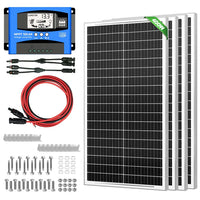


When shopping for solar panels, most people focus on one number: wattage. "I need 400-watt panels," they say, or "Should I get 500-watt or 450-watt modules?" While panel wattage matters, it's actually not the most important factor determining how much electricity your EcoBoss system will produce.
The real key to solar energy production? Peak sun hours—the quality and intensity of sunlight your location receives.
Two homes with identical solar systems can produce vastly different amounts of electricity based solely on their peak sun hours. Understanding this concept is essential for sizing your system correctly and setting realistic expectations about solar performance.
What Are Peak Sun Hours?
A peak sun hour is defined as one hour in which the intensity of solar irradiance (sunlight) reaches an average of 1,000 watts (W) of energy per square meter (roughly 10.5 feet). Another way to put it: A peak sun hour is the equivalent of 1000 W/m² of sunlight for an hour.
This is not simply "hours of daylight." Peak sun hours represent the equivalent time your panels receive full-strength sunlight capable of producing maximum power.
Don't confuse peak sun hours with total daylight hours — they're not the same. Daylight hours make up the entire time between sunrise and sunset. Peak sun hours are specifically the period when the sun's intensity is sufficient for highly effective solar power generation.
Why This Standard Matters
That amount of sunlight – 1000 W/m² over an hour – also happens to be the exact amount of sunlight used to test and rate solar panels in the lab. That means that over the course of a peak sun hour, a solar panel should be producing – before system losses due to temperature and other factors – at close to its specified output rating.
In layman's terms, a 100-Watt panel will produce approximately 100 Watts of energy in one sun hour, minus system losses.
This direct relationship makes peak sun hours the critical multiplier for calculating real-world energy production.
The Wattage Misconception
Here's where many solar buyers go wrong: they assume a 400W panel automatically produces 400 watts of power whenever the sun is shining. This isn't true.
Solar panels are rated in watts based on how much power they can produce under Standard Test Conditions (STC): 1,000 W/m² of sunlight, 25°C (77°F) temperature, and optimal angle. This wattage rating represents the panel's peak output in a lab setting, not in real-world conditions.
For example, a 400W panel will only output near 400W of power during peak sunlight rather than most hours of the day.
What Wattage Actually Tells You
Panel wattage is like a car's horsepower—it tells you the maximum potential under ideal conditions, not what you'll actually get during normal driving.
Panel wattage represents:
- Maximum power under perfect lab conditions
- A useful comparison metric between different panels
- The baseline for calculating potential production
Panel wattage does NOT represent:
- Actual hourly output during most daylight hours
- Total daily energy production
- Real-world performance in your specific location
Peak Sun Hours: The Missing Multiplier
The energy production formula that actually works in the real world is:
Daily Energy (kWh) = Panel Wattage × Peak Sun Hours × System Efficiency
To estimate daily energy production from a single panel, a simple formula can be used: Panel Wattage: Look for your panel's rated output (e.g., 400 W). Peak Sun Hours: The number of hours when sunlight intensity averages 1,000 W/m². Varies by location.
Notice how peak sun hours acts as the critical multiplier. This is why location matters more than most people realize.
Real-World Example: Same Panel, Different Results
Arizona, for example, receives an average of 7.5 peak sun hours each day, while Alaska only gets 2.5. So, a 400-watt panel in Arizona can generate 3 kWh in a day versus just 1 kWh in Alaska.
The same 400W panel produces:
- Phoenix, AZ (7.5 PSH): 400W × 7.5 × 0.85 = 2,550 Wh (2.55 kWh) daily
- Seattle, WA (3.4 PSH): 400W × 3.4 × 0.85 = 1,156 Wh (1.16 kWh) daily
That's a 120% difference in daily production from the exact same panel—purely due to peak sun hours.
The same 400-watt panel produces 1,022 kWh annually in Phoenix but only 496 kWh in Seattle—more than double the difference.
Geographic Variations in Peak Sun Hours
Locations closer to the equator tend to get more consistent and intense sunlight year-round compared to areas farther away.
United States Peak Sun Hours
The states with the highest average peak sun hours are Arizona, Nevada, New Mexico, and California.
High-sun regions (6.0-7.5 PSH daily):
- Arizona: 6.5-7.5 PSH
- Nevada: 6.0-7.0 PSH
- Southern California: 5.5-6.5 PSH
- New Mexico: 6.0-6.5 PSH
- Texas (west): 5.5-6.0 PSH
Moderate-sun regions (4.0-5.5 PSH daily):
- Colorado: 5.0-5.5 PSH
- Florida: 4.5-5.5 PSH
- Georgia: 4.5-5.0 PSH
- North Carolina: 4.5-5.0 PSH
Lower-sun regions (3.0-4.5 PSH daily):
- Washington: 3.2-3.8 PSH
- Oregon: 3.5-4.2 PSH
- Pennsylvania: 3.8-4.3 PSH
- Michigan: 3.5-4.0 PSH
- Alaska: 2.5-3.5 PSH
For optimal performance, aim for at least 4-6 peak sun hours daily.
International Comparisons
Different countries have different PSH values. The average daily values region-wise are Germany (3.2), Australia (5.5), India (5.2), U.S. Southwest (6.0), South Africa (5.8).
Peak sun hours range from 2.5-4.0 in the UK to 5.5-7.5 in the Southwest US.
Why More Watts ≠ More Energy
Here's a critical insight many solar buyers miss: a higher-wattage panel in a low-sun location often produces less energy than a lower-wattage panel in a high-sun location.
Comparison Example
System A: Michigan
- 25 × 500W panels = 12.5 kW system
- Peak sun hours: 3.8 daily
- Annual production: 12,500W × 3.8 × 365 × 0.85 = 14,734 kWh
System B: Arizona
- 25 × 400W panels = 10.0 kW system
- Peak sun hours: 7.0 daily
- Annual production: 10,000W × 7.0 × 365 × 0.85 = 21,718 kWh
The smaller Arizona system with lower-wattage panels produces 47% more energy annually than the larger Michigan system with higher-wattage panels.
Understanding this concept is important because it directly impacts your system's energy production and your return on investment.
Seasonal Variations in Peak Sun Hours
Peak sun hours aren't constant throughout the year—they vary significantly by season.
Peak sunlight hours can vary by season due to changes in the sun's angle and the length of daylight. For instance, summer months typically offer more peak sun hours as the sun is higher in the sky and days are longer, while winter months provide fewer peak sun hours due to lower sun angles and shorter days.
Typical Seasonal Pattern (Mid-Latitude Location)
- Summer: 6-7 peak sun hours daily
- Spring/Fall: 4.5-5.5 peak sun hours daily
- Winter: 3-4 peak sun hours daily
For example, in Austin, Texas, peak sun hours per day range from over six in the summer to under three in the winter. Here, the solar panel from above could generate over two kWh per day in the summer (320W x 6.5 hours) or less than one kWh (320W x 3 hours) in the winter.
This means your EcoBoss system will produce significantly more energy in summer than winter—even on equally sunny days—simply due to sun angle and day length.
Factors Affecting Peak Sun Hours at Your Location
1. Geographic Latitude
In latitudes farther north, when the sun is closer to the horizon, the sunlight is filtered through more layers of the atmosphere. In those places, the sunlight isn't as strong by the time it reaches your solar panels, which results in lower peak sun hours.
The closer you are to the equator, the more direct sunlight reaches your panels throughout the year.
2. Local Weather Patterns
Factors like cloud cover and atmospheric pollution can also affect the amount of solar energy you get at any given time, impacting peak sunlight hours.
According to the U.S. Department of Energy, when solar radiation reaches the Earth's surface without being diffused it's known as "direct beam radiation"; however, atmospheric conditions can reduce this radiation by 10% on clear, dry days and up to 100% on foggy, hazy, and cloudy days.
3. Shading and Obstructions
Local shading from trees, buildings, or chimneys directly reduces the effective peak sun hours your panels receive. Shading: Properties with large trees or buildings obstructing the roof can block some sunlight from reaching a photovoltaic system.
4. Panel Orientation and Tilt
Roof orientation: South-facing roofs typically have the most optimum angle for sunlight (in the Northern Hemisphere).
Panels facing suboptimal directions or at incorrect tilt angles effectively receive fewer peak sun hours because they're not positioned to capture maximum intensity sunlight.
Sizing Your System: Why Peak Sun Hours Come First
When designing your EcoBoss solar system, peak sun hours should drive the calculation—not panel wattage preferences.
The Correct Sizing Process
Step 1: Determine daily energy consumption Average household: 30 kWh/day
Step 2: Identify local peak sun hours Example location: 5.0 PSH
Step 3: Calculate required system size System Size (kW) = Daily kWh ÷ (Peak Sun Hours × System Efficiency) System Size = 30 ÷ (5.0 × 0.85) = 7.06 kW needed
Step 4: Select panel wattage based on available space
- If using 400W panels: 7,060W ÷ 400W = 18 panels needed
- If using 500W panels: 7,060W ÷ 500W = 15 panels needed
Notice how peak sun hours determined the system size, while panel wattage only affected the panel count.
Common Sizing Mistake
Many homeowners say: "I want twenty 400W panels" without considering their location's peak sun hours. This approach leads to:
- Oversized systems in high-sun areas (wasting money)
- Undersized systems in low-sun areas (not meeting energy needs)
Peak sun hours play a crucial role in determining the appropriately sized solar panel system that will meet your energy needs. A too-small system likely won't generate enough power to meet your needs. Meanwhile, an oversized system may generate excess energy that you don't use.
Real-World Energy Production Examples
Let's examine how the same panels perform in different peak sun hour locations:
400W Panel Annual Production by Location
Using the 400W example: Daily production varies dramatically by location based on peak sun hours. In California (Los Angeles) with 5.5-6 peak sun hours: 400W x 5.5 hours = 2,200 Wh or 2.2 kWh/day, monthly production (~30 days): 2.2 kWh x 30 ≈ 66 kWh/month per panel.
Phoenix, AZ (7.0 PSH):
- Daily: 2.38 kWh
- Annual: 868 kWh
Denver, CO (5.5 PSH):
- Daily: 1.87 kWh
- Annual: 682 kWh
Seattle, WA (3.4 PSH):
- Daily: 1.16 kWh
- Annual: 423 kWh
Same 400W panel, different locations = 205% production variance
System-Level Impact
A typical 20-panel (8kW) residential system:
| Location | Daily Production | Annual Production |
|---|---|---|
| Phoenix | 47.6 kWh | 17,360 kWh |
| Denver | 37.4 kWh | 13,640 kWh |
| Seattle | 23.2 kWh | 8,460 kWh |
The Phoenix system produces more than double the Seattle system despite identical equipment.
Calculating Your Peak Sun Hours
You can find solar irradiance data from reliable sources like the National Solar Radiation Database. It provides U.S. and international solar radiation data and information about the meteorological year.
Method 1: Online Databases
The National Renewable Energy Laboratory (NREL) created the PVWatts Calculator, which offers the available photovoltaic energy production based on your physical address.
Simply enter your address to get precise peak sun hour data.
Method 2: Solar Irradiance Calculation
Solar irradiance is the amount of solar energy that reaches a specific area over a unit of time. You usually measure this data in watts per square meter (W/m²).
Formula:
- Find daily solar irradiance for your location (kWh/m²/day)
- Divide by 1.0 kW/m² (the peak sun standard)
- Result = daily peak sun hours
Example: Location receives 5.2 kWh/m²/day Peak sun hours = 5.2 ÷ 1.0 = 5.2 hours daily
Method 3: Professional Assessment
Your EcoBoss solar consultant can provide accurate peak sun hour data specific to your exact location, accounting for local microclimates, typical weather patterns, and seasonal variations.
Optimizing for Your Peak Sun Hours
Once you understand your location's peak sun hours, you can optimize your EcoBoss system design:
1. Orient Panels for Maximum Exposure
In the Northern Hemisphere, panels should always face true south. A south-facing orientation exposes the panel to the sun for the longest period each day.
Proper orientation ensures you capture the maximum available peak sun hours.
2. Adjust System Size Appropriately
Work with Local Experts: Solar installers familiar with your area's specific PSH patterns, weather challenges, and utility policies can design systems that maximize your return on investment.
In low-sun areas, slightly oversizing your system compensates for fewer peak sun hours. In high-sun areas, you may need fewer panels than you initially thought.
3. Consider Seasonal Patterns
Plan for Seasonal Variation: Size your system based on annual averages, but understand that winter months may require grid electricity while summer months might generate excess power for net metering credits.
4. Battery Storage Alignment
Your solar panels will reach their maximum effectiveness when the sun's intensity is highest. They will likely produce excess electricity at this time. Installing a solar battery system can ensure you can capture all the energy you generated.
Investing in a battery backup system will help you store and use the generated electricity later when peak sun hours have passed.
5. Manage Expectations Realistically
More peak sun hours mean higher energy production, which can reduce your dependence on grid electricity and lower your energy bills.
But understanding your actual peak sun hours prevents disappointment and helps set realistic production expectations.
The Economics: Peak Sun Hours = Money
Peak sun hours directly translate to financial returns on your solar investment.
However, the availability of terrific solar incentives means that even with less energy production, the average solar payback period for homeowners there is just 2.8-3.4 years - a level of return that's hard to beat.
ROI Comparison
High-sun location (6.5 PSH, Phoenix):
- 8kW system cost: $20,000
- Annual production: 17,360 kWh
- Annual savings at $0.13/kWh: $2,256
- Simple payback: 8.9 years
Low-sun location (3.8 PSH, Seattle):
- 8kW system cost: $20,000
- Annual production: 9,690 kWh
- Annual savings at $0.13/kWh: $1,260
- Simple payback: 15.9 years
Or, resize for equivalent production:
- 14kW system in Seattle
- Annual production: 17,010 kWh (nearly matching Phoenix)
- System cost: $35,000
- Annual savings: $2,211
- Simple payback: 15.8 years
This illustrates why peak sun hours must drive system sizing decisions to achieve target energy production and financial returns.
When Peak Sun Hours Are Low: Is Solar Still Worth It?
In locations with fewer sunny days, generous incentives can still make solar panels worth it.
Even in states with low peak sun hours, high electricity bills and terrific state solar incentives have made solar energy a profitable recommendation.
Success Factors in Low-Sun Regions
- Higher electricity rates offset lower production
- Better incentives reduce upfront costs
- Proper system sizing ensures adequate energy
- High-efficiency panels maximize limited sunlight
- Optimal orientation captures every available peak sun hour
Whether you're in sunny Arizona with 7+ PSH or cloudy Seattle with 3.5 PSH, solar can deliver huge savings when properly planned. The key is working with experienced professionals who understand how to harness your area's unique solar resource.
The Bottom Line
When evaluating solar panels for your EcoBoss system, remember this hierarchy:
Most Important:
- Peak sun hours at your location
- Your energy consumption
- System size needed
Less Important: 4. Individual panel wattage 5. Panel brand preferences 6. Aesthetic considerations
You must remember that only total sunlight hours are not enough, but peak sun hours are what really matters. This number will determine if solar panels are a worthy investment.
A 400W panel in Phoenix produces more than double the energy of the same 400W panel in Seattle—not because the panel is different, but because Phoenix receives 7.0 peak sun hours daily compared to Seattle's 3.4 hours.
The wattage on the spec sheet is just a number. Peak sun hours are what turn that number into real energy production, real cost savings, and real environmental impact.
When your EcoBoss solar consultant designs your system, they start with your location's peak sun hours—because that's what truly matters for determining how much clean energy you'll produce and how quickly your investment will pay off.
Abstract
Solar panel wattage represents laboratory maximum output, but peak sun hours determine real-world energy production. A 400W panel produces 2.55 kWh daily in Phoenix (7.5 peak sun hours) versus only 1.16 kWh in Seattle (3.4 peak sun hours)—a 120% difference from identical equipment. Peak sun hours measure equivalent time receiving 1,000 W/m² solar intensity, the same standard used to rate panels, making it the critical multiplier in the production formula: Daily kWh = Panel Wattage × Peak Sun Hours × 0.85 efficiency. Geographic variations are dramatic: southwestern US averages 6.0-7.5 PSH, moderate regions 4.0-5.5 PSH, and northern areas 3.0-4.5 PSH. The same 20-panel system produces 17,360 kWh annually in Phoenix but only 8,460 kWh in Seattle. Proper system sizing must account for local peak sun hours first, then select panel wattage based on available space—not the reverse. Even low-sun regions can achieve strong solar ROI through proper sizing, high-efficiency panels, and favorable local incentives.
Keywords: peak sun hours, solar irradiance, panel wattage vs production, geographic solar variations, system sizing calculations


